Woven fabric manufacturing creates fabric by interlacing threads. This intricate process consists of several key steps, including preparation, weaving, and finishing. Each stage significantly influences the final product’s quality and characteristics. For instance, studies show that treatment processes can alter mechanical parameters and surface properties of the fabric. Understanding woven fabric manufacturing enhances appreciation for the textiles used in everyday life.
Key Takeaways
- Woven fabric manufacturing involves interlacing threads through preparation, weaving, and finishing stages.
- Sourcing high-quality yarn is crucial; materials like polyester and cotton significantly impact fabric properties.
- Proper yarn preparation techniques, such as winding and sizing, ensure optimal weaving conditions and fabric quality.
- Loom setup is essential; different types of looms, like handlooms and power looms, serve various production needs.
- Understanding warp and weft threads helps in recognizing their roles in fabric structure and design.
- Maintaining proper tension during weaving is vital for fabric strength and durability, preventing production issues.
- Finishing processes enhance the appearance and performance of fabrics, making them market-ready and suitable for specific uses.
- Different weave types, such as plain, twill, and satin, offer unique characteristics that influence fabric applications.
Overview of the Woven Fabric Manufacturing Process
Preparation of Materials
Sourcing Yarn
The first step in woven fabric manufacturing involves sourcing high-quality yarn. Manufacturers typically select from a variety of raw materials, each contributing unique properties to the final fabric. The most commonly used raw materials include:
| Raw Material | Market Share (%) |
|---|---|
| Cotton | 30 |
| Polyester | 50 |
| Silk | 4–5 |
| Wool | 3–4 |
| Nylon | 7 |
Polyester dominates the market due to its durability and versatility. Cotton remains popular for its softness and breathability. Each material’s characteristics influence the fabric’s texture, strength, and overall performance.
Yarn Preparation Techniques
Once the yarn is sourced, manufacturers employ various preparation techniques to ensure optimal weaving conditions. Key steps include:
- Yarn Winding: This process ensures that the yarn is wound onto spools or cones without tangles. Proper winding is crucial for maintaining yarn quality during weaving.
- Warping to Form Fabric Sheets: Manufacturers create warp sheets by arranging the yarn in parallel lines. This step allows for quality inspection before weaving begins.
- Sizing the Threads: Sizing involves applying a protective coating to the yarn, enhancing its strength and reducing friction during weaving. This step ensures uniform quality, resulting in long-lasting fabric.
The preparation of materials is vital for achieving high-quality woven fabric.
Setting Up the Loom
Types of Looms
Looms are essential machines in woven fabric manufacturing. They come in various types, each suited for specific weaving needs. The primary categories include:
- Handlooms: Operated manually, these looms allow for intricate designs and patterns. They are often used for artisanal fabrics.
- Power Looms: These automated machines increase production speed and efficiency, making them ideal for mass production.
Loom Setup Procedures
Setting up a loom requires meticulous attention to detail. The essential steps include:
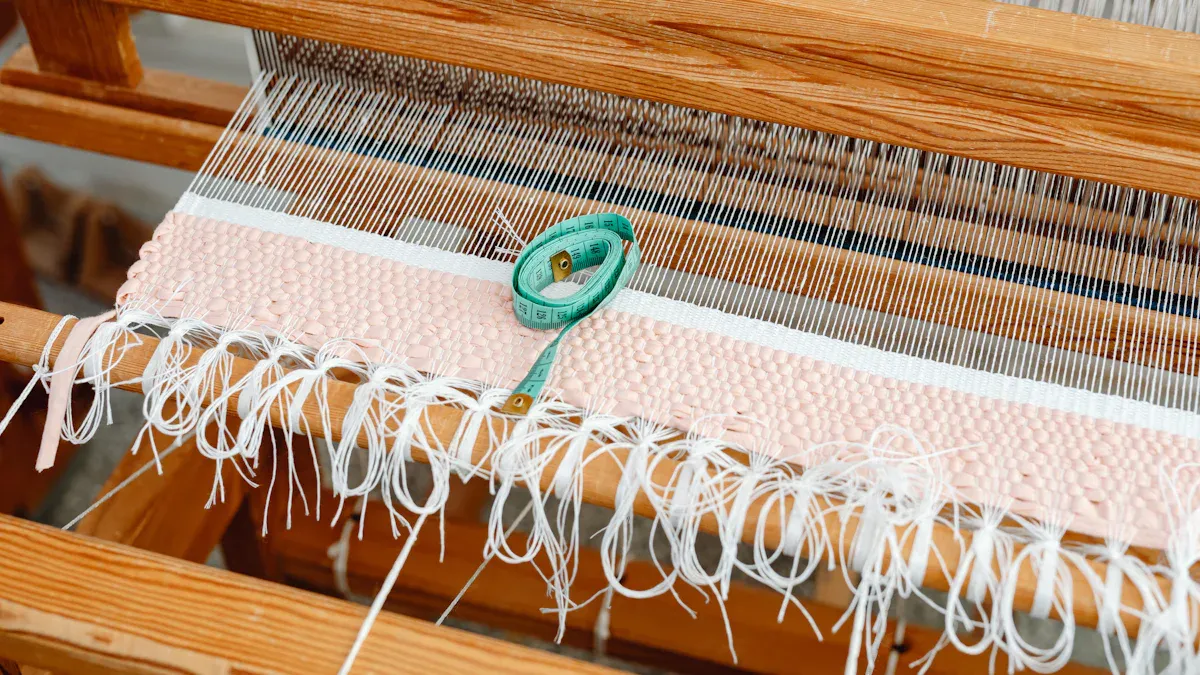
- Begin by meticulously loading the warp yarn onto the warp beam, ensuring it threads through the reeds and heddles in the precise sequence.
- Utilize the harness to elevate a set of warp threads, forming the shed, and guide the shuttle through this shed to interlace the weft yarn.
- Employ the reed to press the newly woven weft thread towards the fabric.
- Automate the winding of the completed fabric onto the take-up roller.
- Rigorously inspect the fabric post-weaving for any imperfections.
Drawing-in is the last warp preparation step, where each warp yarn is drawn through the appropriate loom elements. This step is critical as it ensures that if a yarn breaks, the associated drop wire stops the weaving machine, thus maintaining the efficiency and accuracy of the weaving process.
The setup procedures significantly affect weaving efficiency and fabric quality. For instance, warp tension plays a crucial role in determining weavability limits. Proper adjustments can enhance the overall weaving process, leading to superior fabric outcomes.
Key Terms in Woven Fabric Manufacturing
Understanding Warp and Weft
Definition of Warp
In woven fabric manufacturing, warp refers to the set of threads that run vertically along the length of the fabric. These threads provide the structural foundation and stability necessary for the fabric. Warp threads undergo processes such as winding, sizing, and drawing-in, which prepare them for weaving. They are typically thicker and stronger than weft threads, allowing them to withstand higher tension during the weaving process.
Definition of Weft
Conversely, the weft consists of threads that run horizontally across the fabric’s width. These threads fill in the gaps between the warp threads, creating the fabric’s overall design and texture. Weft threads are generally thinner and less strong than warp threads. They play a crucial role in influencing the fabric’s appearance and properties, such as softness and flexibility.
To illustrate the differences between warp and weft, consider the following table:
| Comparison parameters | WARP | WEFT |
|---|---|---|
| Direction | Vertical/lengthwise | Horizontal/widthwise |
| Processing | Winding, warp, sizing, and drawing-in | Weft winding |
| Thickness | Thicker | Thinner |
| Length | Longer, equal to a fabric’s length | Shorter, equal to a fabric’s width |
| Degree of twist | Higher | Relatively lower |
| Tension | Higher | Lower |
| Stretch | Lower | Higher |
| Density | Usually higher | Lower |
| Strength | Stronger | Less strong |
| Visibility | Hidden in the fabric | More visible |
| Texture | Even, smooth, rigid | Soft, uniform |
| Function | Foundation, structural support | Filling, pattern-creating |
The Role of Tension
Importance of Tension in Weaving
Tension plays a critical role in woven fabric manufacturing. Proper tension ensures that the warp threads remain taut during the weaving process, which directly affects the fabric’s strength and durability. Insufficient tension can lead to loose threads, resulting in a weak fabric structure. Conversely, excessive tension may cause the threads to break, leading to production delays and increased waste.
The following table highlights how different fabric types compare in terms of tensile strength:
| Fabric Type | Tensile Strength Comparison | Notes |
|---|---|---|
| Plain Weave | Higher than Twill 2/1 | Stronger than Twill 2/2 |
| Twill 2/1 | Higher than Twill 2/2 | |
| Weft-wise Plain | Higher than Weft-wise Twill | |
| COF Value | Higher in Plain | Indicates better mechanical properties |
| FYF Value | Higher in Satin | Affects fabric stiffness |
Methods to Maintain Tension
Textile experts recommend several effective methods for maintaining tension during weaving:
- Jerking Method: Apply tension by jerking 2″ sections of the warp hard, alternating sides to ensure even tension.
- Body Weight Method: Use body weight by leaning back against the warp while holding 2″ sections at arm’s length for consistent tension.
- Smoothing Technique: Smooth out sections before tensioning to avoid tangles, but avoid combing as it can snag threads.
- Brisk Shake: Shake the warp briskly while pulling it towards you to help maintain tension.
- Taut Hold and Slap: Hold a section taut and slap or flick it to achieve tension.
These methods help ensure that the fabric produced meets the desired quality standards, enhancing its overall performance and longevity.
Types of Weaving Machinery
Weaving machinery plays a crucial role in the production of woven fabrics. The industry utilizes both traditional and modern machines, each offering unique advantages and capabilities.
Traditional Looms
Handlooms
Handlooms represent the oldest form of weaving machinery. They rely on manual operation, allowing skilled artisans to create intricate designs. The advantages of handlooms include:
- Uniqueness: Each piece produced is a one-of-a-kind creation, showcasing the weaver’s craftsmanship.
- Quality: Handlooms often utilize high-quality natural fibers, resulting in breathable and comfortable fabrics.
- Cultural Significance: Handloom weaving preserves traditional techniques and supports local artisans.
However, handlooms have limitations. They produce fabric at a slower rate, typically achieving a weft insertion speed of less than 800 meters per minute. This slower pace results in higher production costs and limited quantities.
Power Looms
Power looms revolutionized the weaving process by introducing automation. These machines significantly enhance productivity, achieving speeds exceeding 1500 meters per minute. Key benefits of power looms include:
- Cost Efficiency: Power looms reduce production costs due to faster output and lower labor requirements.
- Versatility: They can quickly switch between different fabric types, accommodating various designs and patterns.
- Energy Efficiency: Modern power looms consume 20%-30% less energy compared to traditional looms, thanks to optimized power systems.
Despite these advantages, power looms may lack the unique qualities found in handloom fabrics. The craftsmanship and attention to detail often differ, leading to a perception of lower quality.
Modern Weaving Machines
Jacquard Looms
Jacquard looms represent a significant advancement in weaving technology. They allow for the individual control of each warp thread, enabling the creation of highly intricate patterns. The features of Jacquard looms include:
| Feature | Description |
|---|---|
| Control of Warp Threads | Individual control of each thread |
| Pattern Complexity | Capable of producing highly intricate and detailed patterns |
| Automation | Utilizes punched cards for automated pattern control |
The Jacquard loom’s ability to automate complex designs has transformed the industry. It eliminates the need for manual labor in pattern creation, increasing efficiency and consistency.
Air-Jet Looms
Air-jet looms utilize compressed air for weft insertion, achieving high speeds and quality. Their advantages include:
- Speed: Capable of producing up to 2,000 picks per minute, significantly enhancing production efficiency.
- Low Noise: Operate quietly compared to traditional looms, creating a more pleasant working environment.
- Energy Efficiency: Designed to reduce energy consumption while maintaining high performance.
These modern machines are increasingly popular due to their ability to produce high-quality fabrics quickly. The textile industry is shifting towards automation, with air-jet and rapier machines leading the way in speed and fabric quality.
Different Types of Weaves in Woven Fabric Manufacturing
Plain Weave
Characteristics of Plain Weave
Plain weave represents the simplest weaving technique. It forms a basic criss-cross pattern by interlacing warp and weft threads at right angles. This structure results in several defining characteristics:
| Characteristic | Description |
|---|---|
| Weaving Pattern | Simple criss-cross pattern formed by crossing warp and weft threads at right angles. |
| Strength and Durability | Known for its strength and durability, suitable for various applications. |
| Balanced Weave | Warp and weft threads have the same weight and number of threads per inch, enhancing stability. |
| Checkerboard-Like Appearance | Exhibits a classic look due to the over-and-under pattern of threads. |
| Versatility | Can be made from various materials, used in clothing, upholstery, and crafts. |
| Altering Appearance | Visual appearance can be changed by using different yarns, allowing for design customization. |
Applications of Plain Weave
Plain weave fabrics find extensive use across multiple industries due to their durability and versatility. Common applications include:
- Clothing: Used for shirts, dresses, and uniforms due to comfort and durability.
- Home Furnishings: Applied in curtains, tablecloths, and cushion covers.
- Industrial Use: Utilized in filters, bags, and upholstery for its sturdy structure.
In the fashion industry, plain weave fabrics are valued for their durability and versatility, making them suitable for a variety of apparel and accessories. They also serve practical purposes in the food industry, where they filter fruit juice and wine, such as cheesecloth.
Twill Weave
Characteristics of Twill Weave
Twill weave differs from plain weave by featuring a diagonal pattern. This unique structure enhances both durability and visual appeal. Key characteristics include:
- Diagonal Lines: Twill weaves create diagonal lines or ribs, adding depth and texture to the fabric.
- Durability: Generally stronger and more resistant to wear and tear than plain weaves.
- Maintenance: Twill fabrics conceal dirt and stains better, making them easier to clean.
| Feature | Twill Weave | Plain Weave |
|---|---|---|
| Appearance | Diagonal lines or ribs, adds depth and texture | Uniform grid-like pattern |
| Durability | Stronger and more resistant to wear and tear | Slightly stronger due to tighter packing |
Applications of Twill Weave
Twill weave fabrics are widely used in various sectors, including:
- Clothing: Commonly found in denim jeans, jackets, and skirts due to their durability.
- Upholstery: Ideal for furniture and home textiles, providing elegance and strength.
- Workwear: Utilized in uniforms and coveralls, offering robustness for heavy-duty applications.
Satin Weave
Characteristics of Satin Weave
Satin weave is renowned for its luxurious appearance and smooth texture. This weave technique allows warp yarns to float over weft yarns, resulting in a glossy surface. Key features include:
- Glossy Finish: The unique arrangement creates a high degree of luster, making satin a favored choice for formal garments.
- Soft Texture: The minimal interlacing of yarns contributes to a soft and luxurious feel.
Satin’s allure stems from its distinctive weaving technique, where warp yarns float over weft yarns with minimal interlacing. This results in a smooth and lustrous surface that is visually striking.
Applications of Satin Weave
Satin fabrics find extensive use in the fashion and home decor sectors. Common applications include:
- Fashion: Used for elegant dresses, blouses, skirts, and lingerie due to its luxurious appearance.
- Home Decor: Commonly utilized in bedding and curtains, providing a sophisticated look to interiors.
Satin’s unique properties make it ideal for couture wedding gowns, evening wear, and luxurious home furnishings.
Finishing Processes in Woven Fabric Manufacturing
Finishing processes play a crucial role in woven fabric manufacturing. These processes transform raw fabric into a polished product suitable for its intended use. They enhance the appearance, texture, and performance of textiles, ensuring they meet customer expectations and industry standards.
Types of Finishing Techniques
Mechanical Finishing
Mechanical finishing involves physical methods to alter the fabric’s surface or structure. These techniques significantly enhance the texture and durability of woven fabrics. Common mechanical finishing processes include:
- Brushing: This technique softens fabrics like flannel by lifting fibers to create a fuzzy texture, enhancing warmth and comfort.
- Calendering: This process increases smoothness and sheen by pressing fabric between heated rollers, resulting in a refined finish.
- Sanforized Finish: This method pre-shrinks fabric to prevent excessive shrinkage after washing, improving the garment’s fit and durability.
These mechanical processes not only improve the aesthetic appeal of woven fabrics but also significantly enhance their durability. For instance, heat setting minimizes shrinkage and wrinkling, while calendaring condenses fibers to create various textures.
Chemical Finishing
Chemical finishing applies special substances to impart new properties to the fabric. This technique modifies the chemical composition of textiles, enhancing their longevity and performance. Common chemical finishing methods include:
- Waterproofing: This treatment creates a barrier against water, allowing it to bead up and roll off while maintaining breathability.
- Wrinkle-resistant: Resins help fabric resist wrinkles, reducing the need for ironing and keeping clothes looking neat.
- Flame retardant: This treatment reduces the likelihood of fabric catching fire, enhancing safety for items like children’s sleepwear.
Chemical finishing is essential for creating fabrics tailored for various industries. It adds specific aesthetic and technical qualities to each fabric, ensuring they meet market demands.
Importance of Finishing
Finishing processes are critical in woven fabric manufacturing for several reasons:
Enhancing Fabric Properties
Finishing techniques significantly improve the look, feel, and functionality of textiles. They transform greige fabric into market-ready materials, enhancing their value. Processes like washing, heat setting, and coating can drastically change the fabric’s properties, making them suitable for specific applications. For example, the development of processes to control shrinkage has greatly improved fabric performance, ensuring that the final product meets consumer expectations.
Preparing for Market
Finishing ensures that fabrics meet customer expectations and industry standards. It involves a set of chemical, physical, and mechanical treatments executed after weaving. These treatments improve aesthetic qualities and add specific technical properties based on intended use. As market demands focus on color consistency and specialized performance attributes, finishing processes become increasingly important. Sustainable processing methods also address consumer concerns about environmental impact, making them vital for modern textile production.
The woven fabric manufacturing process encompasses multiple stages, from preparation to finishing. Each step plays a vital role in ensuring that fabrics meet both functional and aesthetic requirements. Key factors impacting textile quality include the quality of raw materials, the character of the yarn spun from fibers, the density of the weave, and the finishing processes. Understanding these intricacies allows professionals to select appropriate materials for specific applications. Consumers also benefit by making informed choices based on the characteristics of different weaves, enhancing their satisfaction with textile products. Knowledge of this process ultimately enriches appreciation for the textiles used in daily life.
FAQ
What is woven fabric?
Woven fabric consists of threads interlaced at right angles. This technique creates a stable structure, making it suitable for various applications, including clothing, upholstery, and industrial uses.
How is yarn prepared for weaving?
Yarn preparation involves winding, warping, and sizing. These steps ensure the yarn is tangle-free, aligned, and coated for strength, enhancing the weaving process’s efficiency.
What are the main types of looms?
The primary types of looms include handlooms and power looms. Handlooms allow for intricate designs, while power looms automate production, increasing speed and efficiency.
What is the difference between warp and weft?
Warp threads run vertically, providing structural support. Weft threads run horizontally, filling the gaps between warp threads. Together, they form the fabric’s overall design and texture.
Why is tension important in weaving?
Tension ensures warp threads remain taut during weaving. Proper tension affects the fabric’s strength and durability, preventing loose threads or breakage during production.
What are common finishing techniques for woven fabrics?
Common finishing techniques include mechanical methods like brushing and calendaring, as well as chemical treatments such as waterproofing and wrinkle resistance. These processes enhance fabric appearance and performance.
What types of weaves exist in woven fabric manufacturing?
Common types of weaves include plain, twill, and satin. Each weave has unique characteristics, influencing the fabric’s texture, strength, and applications.
How does woven fabric differ from knitted fabric?
Woven fabric consists of interlaced threads, while knitted fabric is made from continuous yarn loops. This difference affects their stretch, texture, and typical uses in textiles.